
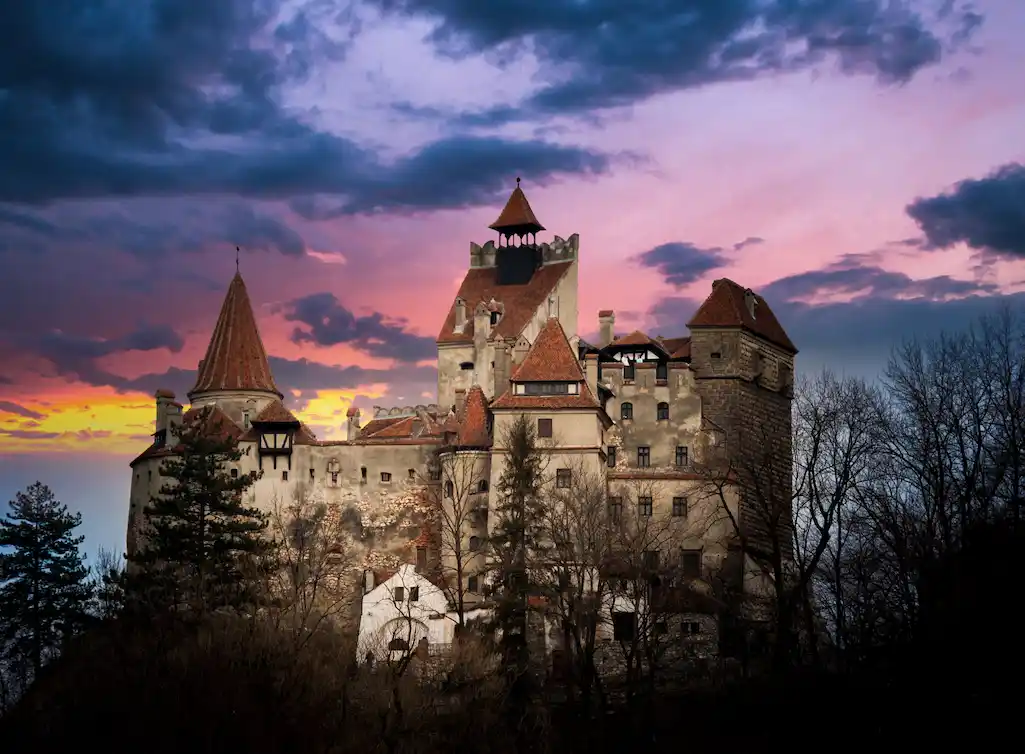
Bran Castle is internationally known as “Dracula’s Castle,” although Bram Stoker never mentioned it in his novel Dracula, published in 1897, and Vlad the Impaler never used the castle as a residence. The connection between Bran, the Wallachian ruler and the fictional character developed during the 20th century through literature, film and tourism.
How Bram Stoker Created Dracula
Bram Stoker never visited Romania. While writing the novel, the Irish author relied on books, maps and accounts of Central and Eastern Europe, building his image of Transylvania from what he read.
In 1890, during a stay in Whitby, England, Stoker consulted An Account of the Principalities of Wallachia and Moldavia, published by William Wilkinson in 1820. From the book, he took the name “Dracula” and Wilkinson’s explanation that the word meant “devil” in Romanian.
Stoker’s surviving notes show that the name Dracula was introduced after a substantial part of the plot had already taken shape. The character originally had a different name.
Stoker also included references in the novel to a ruler who had fought against the Ottomans, but the information he used about Vlad the Impaler was limited. The idea that the Wallachian ruler was the direct and detailed inspiration for Count Dracula became widespread only later.
In the novel, Jonathan Harker arrives in Bistrița and then travels toward the Borgo Pass, generally identified today with Tihuța Pass. The count’s residence is located in an isolated mountainous area of northeastern Transylvania, far from Bran.
Stoker describes a castle standing on the edge of a precipice, surrounded by mountains and forests. There is no evidence that the writer knew of Bran Castle or that the fortress served as a model for Dracula’s fictional home.
Bran Castle was later associated with the fictional residence because of its medieval appearance and its striking position on a rocky outcrop. Its towers, walls and mountain setting matched the image that Western audiences gradually came to associate with Count Dracula’s castle.
How Dracula Became Associated with Bran Castle
Bram Stoker’s novel made the name Dracula famous, while 20th-century film adaptations turned the character into one of the best-known vampires in popular culture. The films also strengthened the association between Dracula and Transylvania.
An important moment came in 1972 with the publication of In Search of Dracula by Raymond T. McNally and Radu Florescu. The book popularized the connection between Count Dracula and Vlad the Impaler among Western audiences and drew attention to places in Romania associated with the ruler.
During the 1970s, Dracula-themed tours began to appear, with Bran included alongside Brașov, Sighișoara and other places connected either with Vlad the Impaler or with the image of Transylvania popularized by the novel and its film adaptations.
Researcher Duncan Light, who has studied the development of tourism in Romania, has shown that the communist authorities were reluctant to promote the country through vampires and supernatural themes.
After 1989, the association between Bran and Dracula expanded rapidly through travel agencies, the international press, souvenirs and popular culture. The name “Dracula’s Castle” became one of the most common ways in which Bran Castle is known outside Romania.
What Was Vlad the Impaler’s Connection to Bran?
Vlad the Impaler did not own Bran Castle, and there is no evidence that the fortress was one of his residences. His connection to Bran is mainly geographical and political, linked to relations between Wallachia and Brașov during the 15th century.
The stone castle was built after King Louis I of Hungary granted the citizens of Brașov the privilege to build the fortress on 19 November 1377. Bran occupied a strategic position on the route linking Brașov with Wallachia through the Bran–Rucăr corridor. Merchants, travelers and troops passed through the area, which also had an important customs point for trade between the two regions.
Vlad the Impaler had tense relations with Brașov and the Transylvanian Saxons, particularly because of their support for rival claimants to the Wallachian throne and disputes over trade. In 1459, the conflict intensified, and Vlad launched military actions against several Saxon settlements near Brașov. The Bran area lay along one of the main routes between the territories controlled by Vlad and southern Transylvania.
In 1920, the city of Brașov presented Bran Castle to Queen Marie of Romania as a sign of gratitude for her contribution to the creation of Greater Romania. The queen transformed the old fortress into a royal residence, while architect Karel Liman oversaw extensive restoration and remodeling work to adapt the interior for use as a home.