
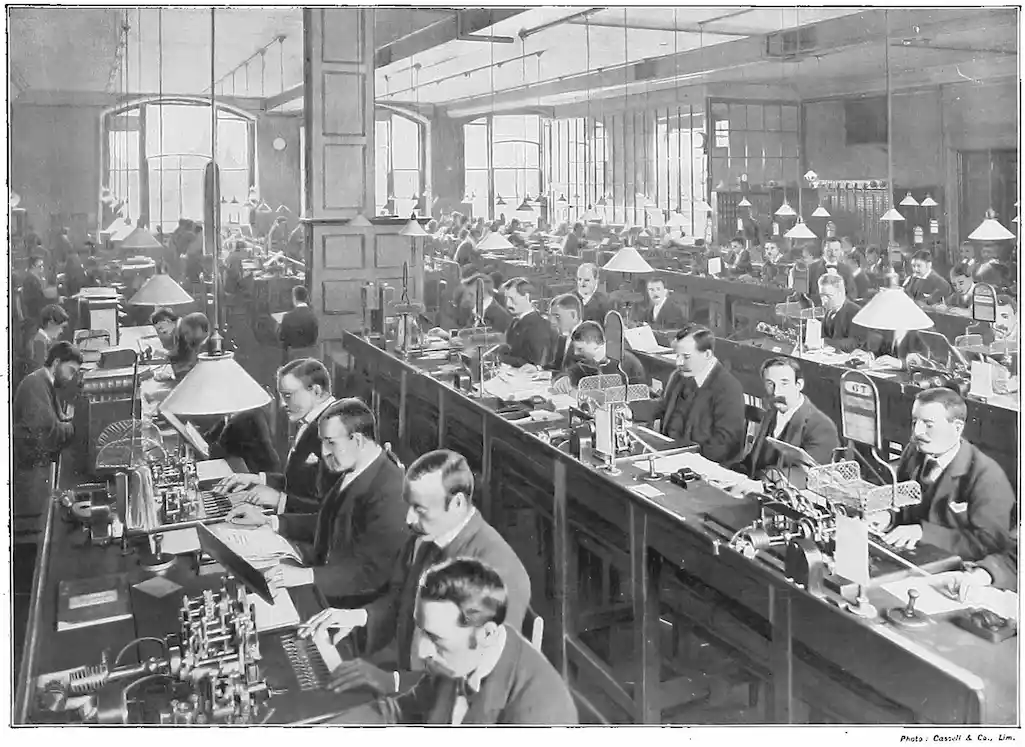
The emergence of news agencies was closely linked to the economic, technological, and social changes of the 19th century. The Industrial Revolution brought rapid growth in cities, trade, and financial markets. Newspaper print runs also increased. Readers wanted the latest news on politics, the economy, wars, and international events, but most newspapers lacked the resources to maintain permanent correspondents in several cities or countries.
During the early decades of the century, news still traveled through couriers, letters, and commercial networks. Merchants, diplomats, and bankers shared information about prices, conflicts, and political developments. Many newspapers published reports without independently verifying their accuracy. Organizations specializing in gathering and distributing news offered a solution for newsrooms that needed timely, reliable information.
The First Modern News Agencies
Agence Havas, founded in Paris in 1835 by Charles-Louis Havas, is generally regarded as the first modern news agency. Initially, it translated reports from foreign newspapers for distribution to the French press. Havas gradually established a network of correspondents and introduced methods for gathering news, turning his agency into a regular supplier of information to numerous newspapers.
The success of the French model inspired similar agencies in other countries. In 1846, several New York newspapers founded the Associated Press, a cooperative intended to reduce telegraph transmission costs and provide news to all its members. In Germany, Bernhard Wolff established Wolffs Telegraphisches Bureau in 1849. Two years later, Paul Julius Reuter founded the news agency that bears his name in London.
The early agencies collected reports from European capitals and distributed them to several newspapers at once. The arrangement reduced costs for individual newsrooms and provided a steady supply of international news.
The Telegraph and the Development of International Networks
The telegraph played a decisive role in the development of news agencies. During the 1840s and 1850s, telegraph lines began connecting major cities in Europe and the United States, reducing the time needed to transmit information from days or weeks to just a few hours. News agencies quickly adopted the technology, becoming major centers for news distribution.
The high cost of telegraph transmissions encouraged cooperation between agencies. During the second half of the 19th century, major European news agencies reached agreements to divide their areas of coverage. Havas dominated news distribution in France and its colonies, Reuters held a strong position throughout the British Empire, while Wolff dominated the German news market.
By the end of the 19th century, major news agencies maintained correspondents in the world’s leading capitals.