
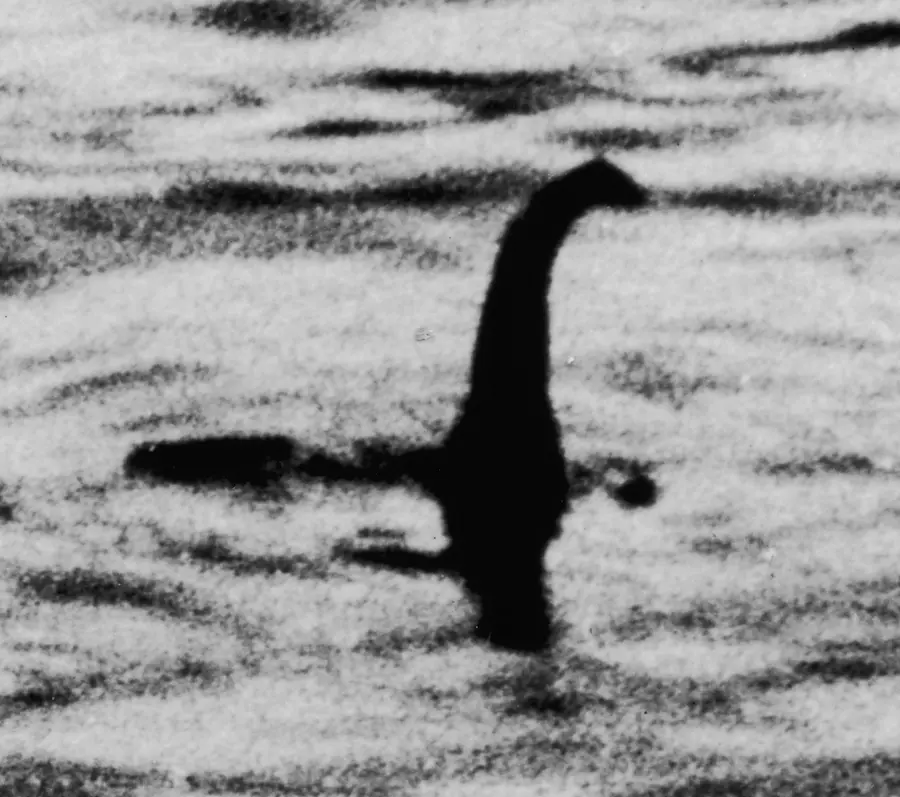
The Loch Ness Monster, commonly known as “Nessie”, is a mysterious creature said to inhabit Loch Ness, a freshwater lake in the Scottish Highlands. The modern legend gained widespread attention in 1933, following reports of an unusual animal seen at the surface of the water. Over the following decades, photographs and films emerged, while researchers investigated the lake using sonar, underwater cameras and, more recently, environmental DNA analysis. To date, no investigation has identified a large, unknown species matching popular descriptions of Nessie.
Loch Ness: A Deep Lake with Dark Waters
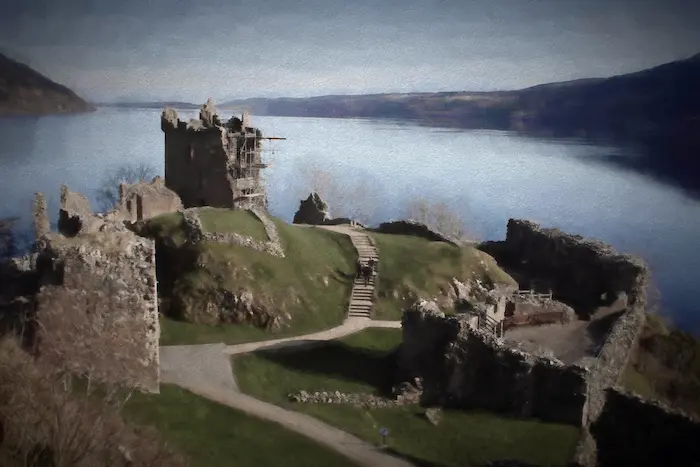
Loch Ness lies in the Great Glen, a valley that cuts across the Scottish Highlands. The lake is approximately 37 kilometres long and reaches depths of more than 200 metres in some areas. By volume, it is one of the largest bodies of freshwater in the British Isles.
The water gets its dark colour from organic matter washed into the loch, mainly from the surrounding peat-rich soils. Very little light reaches the deeper waters, making underwater visibility extremely poor.
In 1996, R. I. Jones and his colleagues published a study in Freshwater Biology examining light availability and phytoplankton growth in Loch Ness. Phytoplankton consists of microscopic organisms that live in water and form an important part of the aquatic food chain. The researchers found that limited light availability severely restricts phytoplankton growth.
Loch Ness is classified as oligotrophic, meaning that it contains relatively low levels of nutrients and supports limited food production within its waters.
The lake’s depth and poor underwater visibility have helped fuel speculation that a large animal could remain hidden for long periods.
Saint Columba and the “Beast” of the River Ness
An account written in the seventh century is often cited as the earliest story of an unusual creature in the Loch Ness area. The episode appears in Vita Sancti Columbae (Life of Saint Columba), a religious work describing the life and miracles of Saint Columba, written by Adomnán, abbot of the monastery on the island of Iona.
According to Adomnán, Columba was travelling among the Picts – the people who inhabited northern and eastern Scotland at the time – when he reached the River Ness. There, he reportedly encountered a group of people burying a man who had been attacked in the water by a “beast”. One of the saint’s companions then entered the river, and the creature approached him. Columba ordered it to retreat, and the animal fled.
The incident takes place in the River Ness, not Loch Ness itself. It also appears in a religious text written approximately a century after Columba’s lifetime.
Jacqueline Borsje examined the account in a study published in the journal Peritia in 1994. She argued that the episode should be understood in the context of a miracle attributed to the saint, rather than as a zoological description in the modern sense.
How the Modern Legend Began
The modern Loch Ness Monster legend began to take shape in the spring of 1933. On 2 May, the Inverness Courier published an account from a couple who claimed to have seen an enormous animal moving at the surface of the lake. British newspapers picked up the story, and public interest in Loch Ness grew rapidly.
Aldie Mackay was travelling with her husband along the road beside the lake when she noticed the water churning and what appeared to be a large shape rolling at the surface. Her description was too vague to identify any particular animal.
Further sightings were reported over the following months, attracting the attention of newspapers beyond Scotland. Loch Ness began drawing visitors, photographers and people hoping to find the mysterious creature.
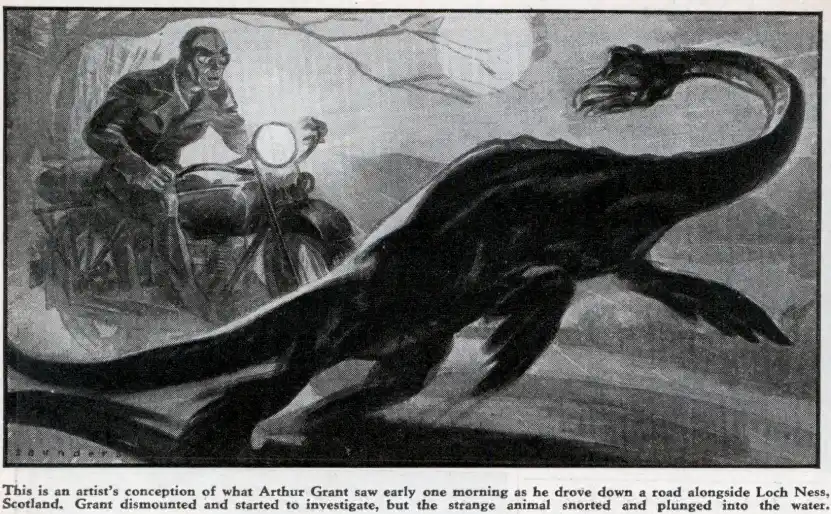
Gradually, the now-familiar image of Nessie emerged: a large animal with a bulky body, a small head and a long neck rising above the water.
The creature’s supposed appearance was frequently compared to that of a plesiosaur. Plesiosaurs were extinct marine reptiles, some of which had exceptionally long necks, massive bodies and four flippers. They lived during the same geological era as the dinosaurs and disappeared approximately 66 million years ago.
The resemblance between scientific reconstructions of plesiosaurs and popular depictions of the Loch Ness Monster helped spread the theory that one of these prehistoric reptiles might have survived.
Zoologists and palaeontologists, however, expressed doubts as early as the 1930s. In November 1934, Nature reported on a discussion held at the Linnean Society of London, one of the world’s oldest scientific societies devoted to the study of nature. Sir Arthur Smith Woodward pointed out that plesiosaur fossils had not been found in much younger geological strata and considered comparisons between the alleged creature and a reptile from the Mesozoic Era unjustified.
The First Photographs
In November 1933, Hugh Gray, a resident of the Loch Ness area, took one of the earliest photographs claimed to show the mysterious creature. Gray was walking along the shore when he noticed something in the water and took several pictures with his Kodak camera. Only one came out clearly enough to be published. The photograph shows an indistinct shape at the surface and has been interpreted in widely different ways, with suggestions ranging from an unknown animal to a dog swimming in the lake.
Far more famous was a photograph published in 1934 and attributed to Robert Kenneth Wilson, a London doctor. The image appeared to show a small head and a long neck rising above the water and quickly became one of the most recognisable images associated with Nessie. Wilson’s professional reputation carried considerable weight at the time. Many people who saw the photograph found it difficult to believe that a respected doctor would take part in a hoax.
The image, now known as the “Surgeon’s Photograph”, was reproduced in newspapers, magazines and books for decades. The most widely circulated version, however, had been cropped. The original frame shows a larger expanse of the lake, making the supposed creature appear considerably smaller than in the famous version.
During the 1990s, the photograph’s origins were re-examined by Alastair Boyd, a former art teacher with a keen interest in the Loch Ness mystery, and his friend David Martin. Their investigation led them to Christian Spurling, the stepson of Marmaduke Wetherell. Spurling claimed that he had made the object shown in the photograph: a small model of a head and neck attached to the conning tower of a toy submarine.
Marmaduke Wetherell was a hunter and adventurer commissioned by the Daily Mail in 1933 to search for evidence of the monster. He had previously been involved in an incident in which footprints presented as evidence of Nessie’s existence were found to have been made using a preserved hippopotamus foot. According to Spurling, Wetherell subsequently arranged the photographic hoax to take revenge on the newspaper after the embarrassment caused by the incident.
Boyd and Martin published their findings, and the hoax explanation became the most widely accepted account of the photograph’s origins. Although not all Loch Ness researchers accepted Spurling’s testimony without reservation, the photograph is no longer regarded as reliable evidence of an unknown creature living in the lake.
What Modern Research Has Found
In 1987, Operation Deepscan used several sonar-equipped boats to survey a large part of Loch Ness. Three unusual sonar readings were recorded in deep water, but they did not reappear when the areas were examined again. None could be linked to an unknown animal.
A different investigation began in 2018, when a team led by geneticist Neil Gemmell of the University of Otago collected approximately 250 water samples. The researchers analysed environmental DNA – genetic traces left in the water by organisms living in the lake. The analysis found no evidence of a large reptile or other unexpected animals.
In 2025, Charles G. M. Paxton, Adrian J. Shine and Valentin M. Popov analysed more than 1,800 reports of Nessie sightings. Their study examined how eyewitness accounts are recorded and interpreted rather than attempting to prove the creature’s existence. In separate research, Paxton and Shine also examined the popular depiction of the monster with several “humps” protruding from the water. They found that such a posture would be difficult to reconcile with the anatomy of a long-bodied animal resembling a snake or an eel.