
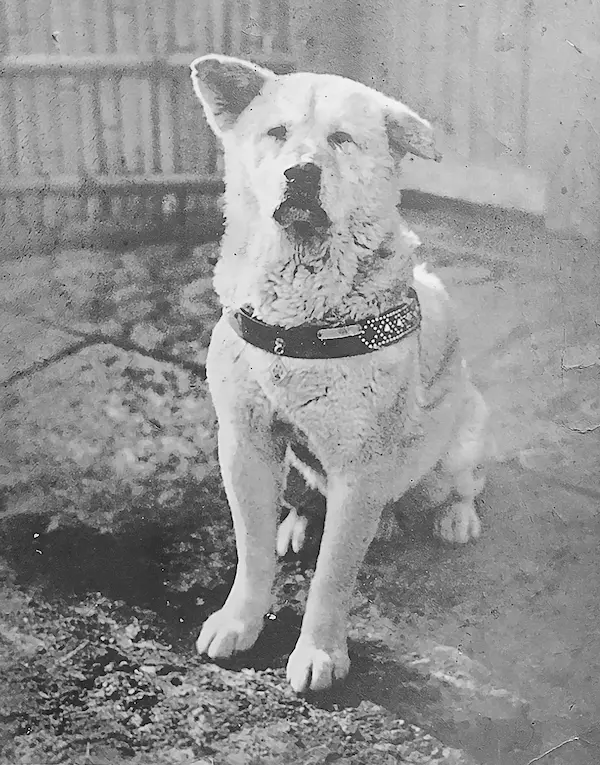
Hachikō, an Akita Inu, was born on 10 November 1923 in Ōdate, Akita Prefecture, in northern Japan. In January 1924, he was taken in by Hidesaburō Ueno, a professor at Tokyo Imperial University.
Hachikō accompanied Ueno each day and would wait for him at Shibuya Station, where the professor arrived by train on his way home from the university. Before long, this became part of their daily routine.
After the Professor’s Death
On 21 May 1925, Hidesaburō Ueno died unexpectedly while at the university. Hachikō was about a year and a half old at the time.
After Ueno’s death, Hachikō was cared for by several people. He eventually went to live with Kikuzaburō Kobayashi, Ueno’s former gardener, who lived nearby.
Hachikō nevertheless continued to return to Shibuya Station, where he had waited for his owner. He kept coming back for years, especially around the time Ueno had usually returned from work.
He soon became a familiar sight around the station. Railway staff, local shopkeepers and commuters who regularly saw him began bringing him food and looking after him.
His story drew the attention of Hirokichi Saitō, who was involved in the study and preservation of native Japanese dog breeds, including the Akita Inu. Saitō began writing about Hachikō and his bond with Ueno.
On 4 October 1932, the Tokyo Asahi Shimbun published an article about the dog that continued to wait at Shibuya Station years after his owner’s death. The article brought Hachikō nationwide attention.
A Symbol of Loyalty in Japan
After the 1932 article, Hachikō became widely known across Japan. His story was picked up by other newspapers and even appeared in school materials, where it was presented as an example of loyalty.
In 1934, a bronze statue of Hachikō was unveiled outside Shibuya Station. Hachikō was still alive and attended the ceremony.
The original statue did not survive the Second World War. It was removed, and the bronze was later used as part of wartime metal collection efforts.
A new statue was erected at the same site in 1948. It still stands outside Shibuya Station and has become one of Tokyo’s best-known meeting places.
Hachikō died on 8 March 1935, after nearly ten years of returning to Shibuya Station.
A post-mortem examination found that he had dirofilariasis, a parasitic disease that can severely affect a dog’s heart and blood vessels. Much later, tests on preserved tissue also revealed malignant tumours in his lungs that had spread to the heart.
Hachikō’s taxidermied remains are preserved at the National Museum of Nature and Science in Tokyo. Some of his organs, preserved after his death, are also kept at the University of Tokyo.
Hachikō’s story has inspired books, films and other cultural works.
In 1987, the Japanese film Hachikō Monogatari was released, based on the dog’s life and his relationship with Professor Ueno.
The story later reached a much wider international audience through the 2009 American film Hachi: A Dog’s Tale. Other adaptations have also been produced in Japan, the United States and China.