
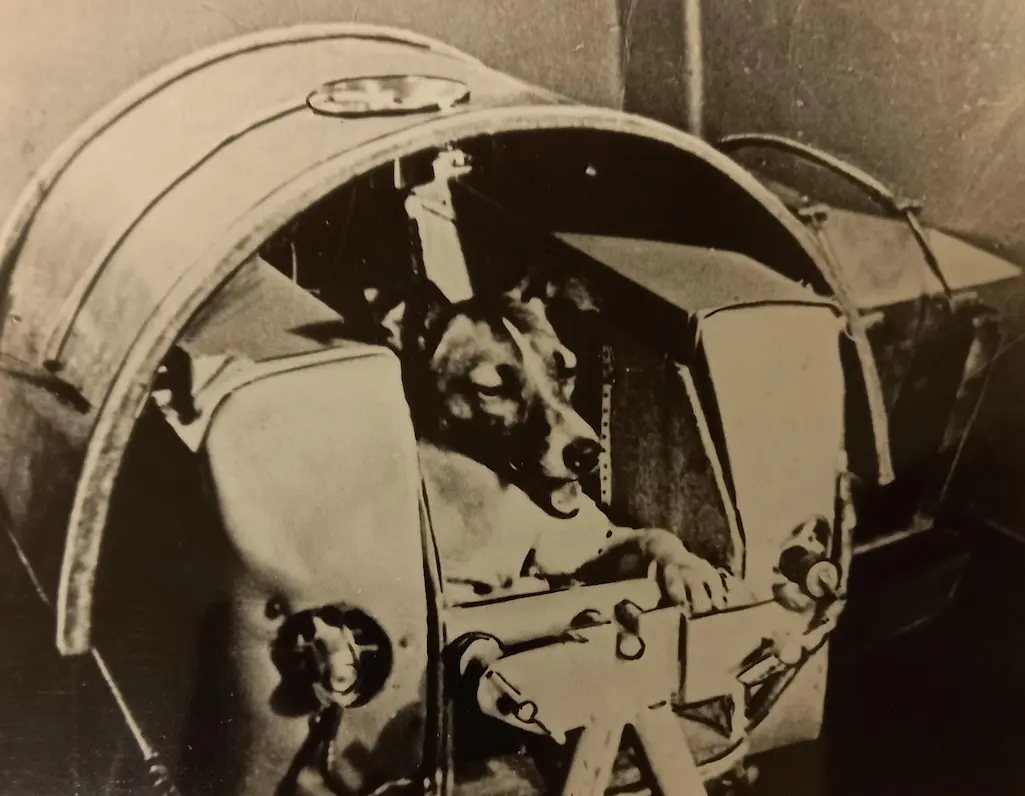
Laika was a stray dog found on the streets of Moscow and selected by Soviet researchers for the space programme. She was about three years old and relatively small, an important advantage given the extremely limited space inside the spacecraft in which she was to fly.
Preparing for the Sputnik 2 Mission
On 3 November 1957, Laika was launched aboard Sputnik 2 and became the first animal to orbit Earth. Other animals had been sent into space before her on suborbital flights, but none had reached orbit.
Laika underwent training for the unusual conditions of the mission. The dogs selected for the Soviet programme were accustomed to very confined spaces, loud noises and vibrations similar to those experienced during a rocket launch.
Sputnik 2 was built in a remarkably short time, less than a month after the launch of the first Sputnik. The compartment designed for Laika was equipped with an oxygen supply, food and instruments that monitored her heart rate, breathing rate and other physiological parameters.
Sputnik 2 was not designed to return to Earth. From the beginning, the researchers knew that Laika could not be brought back after launch.
The experiment was intended to determine whether a living organism could survive launch and orbital flight, and to collect data needed for future crewed space missions.
Launch and Laika’s Death
Sputnik 2 was launched on 3 November 1957 from the Baikonur Cosmodrome. During the launch, instruments on board recorded a sharp increase in Laika’s heart rate and breathing rate as a result of the intense stress of liftoff.
After the spacecraft reached orbit, her heart rate began to fall, but the temperature inside the cabin rose beyond the expected limits.
For several decades, Soviet authorities gave differing accounts of how long Laika survived. One official version maintained that she had lived for several days after the launch.
Information released later showed that she died only a few hours into the mission as a result of overheating and stress. After about five hours, the onboard instruments were no longer detecting signs of life.
Sputnik 2 continued to orbit Earth until 14 April 1958, when it re-entered the atmosphere and burned up.
Laika’s flight showed that a living organism could survive a launch and function, at least for a time, under the conditions of orbital flight. Data transmitted by the instruments on board provided researchers with information about the body’s response to acceleration, vibration, stress and weightlessness.
Soviet experiments involving animals continued. In 1960, the dogs Belka and Strelka were sent into orbit and returned safely to Earth. On 12 April 1961, Yuri Gagarin became the first human to orbit Earth.
The fact that Sputnik 2 had no system for bringing Laika back to Earth drew criticism even at the time of the mission. Her case has remained one of the best-known examples in debates over the use of animals in scientific experiments.
Oleg Gazenko, one of the researchers involved in the Soviet programme that sent dogs into space, later said that, in his view, the results obtained did not justify Laika’s death.
Laika in Popular Culture
Laika became one of the best-known figures from the early years of space exploration. Her image appeared on stamps, postcards, commemorative items and numerous other objects produced in the Soviet Union and other countries.
In 2008, a monument dedicated to Laika was unveiled in Moscow, near the institute where she had been prepared for the Sputnik 2 mission. The monument depicts Laika standing above a rocket-shaped structure.
Her story also inspired works of literature, music and film. In the Swedish film Mitt liv som hund (My Life as a Dog), released in 1985 and directed by Lasse Hallström, the main character repeatedly reflects on Laika’s fate and compares his own problems with those of the dog sent into space.