
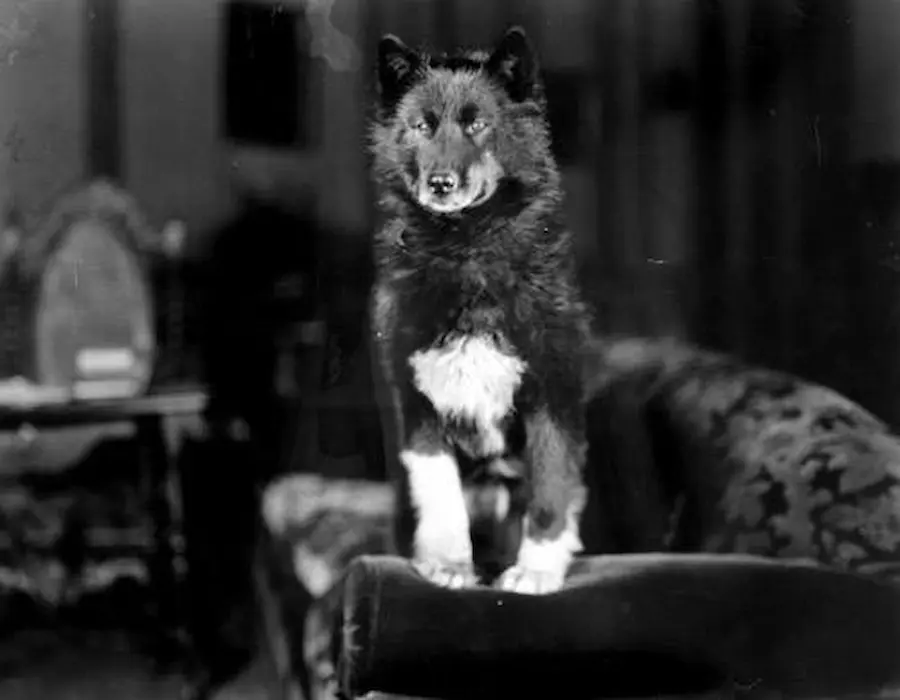
Balto was a sled dog who became famous after leading the final team in the relay that carried diphtheria antitoxin to Nome, Alaska, in February 1925. His role in the final leg of the journey turned him into a symbol of the operation later known as the “Great Race of Mercy.”
The Diphtheria Outbreak in Nome
In January 1925, cases of diphtheria were confirmed in Nome. The infectious disease could be fatal, particularly for children, and local authorities feared that the outbreak might spread. The amount of antitoxin available in the town was insufficient.
Winter conditions made it almost impossible to bring medicine to Nome quickly. The port was blocked by ice, and the weather prevented the use of the aircraft available at the time. The antitoxin was transported by train as far as Nenana, where a relay of dog sled teams took over.
The route from Nenana to Nome covered about 674 miles, or more than 1,080 kilometres. Twenty mushers and more than 150 dogs took part in the relay. They completed the journey in about 127 hours, travelling through extreme cold and blizzard conditions.
Balto and the Final Leg of the Relay
Balto was the lead dog on the team driven by Gunnar Kaasen. The team covered the final stretch to Nome, a distance of about 53 miles, or 85 kilometres.
Conditions worsened along the way. At one point, strong winds overturned the sled, and the container holding the antitoxin fell into the snow. Kaasen managed to recover it and continued toward Nome.
On the morning of 2 February 1925, the team arrived in Nome with the antitoxin. Because Balto had led the final team and appeared in photographs taken after the arrival, his name quickly became associated with the entire operation.
Credit for the relay did not belong to Balto alone. The longest section was covered by Leonhard Seppala and the team led by Togo. Including the journey to the handoff point and the return carrying the antitoxin, Seppala and his dogs travelled about 261 miles, nearly 420 kilometres.
Both Balto and Togo remain closely associated with the history of the 1925 serum run.
Balto Becomes Famous
After the team reached Nome, the story of Balto and Gunnar Kaasen’s team was widely reported in the American press. Balto soon became the public face of the relay.
Balto and the other dogs later appeared with Kaasen at public events across the United States. Their fame, however, did not last long. About two years later, the dogs were sold and ended up in a “dime museum” in Los Angeles, where visitors paid to see a variety of attractions and animals.
There they were seen by George Kimble, a businessman from Cleveland. Disturbed by the conditions in which the dogs were being kept, he decided to try to buy them. Their owner asked for $1,500, and Kimble organized a fundraising campaign to raise the money.
People in Cleveland responded to the campaign. Children, workers, shopkeepers and local organizations contributed, and the full amount was raised in just ten days.
On 19 March 1927, Balto and the six other dogs still with the team – Fox, Billy, Tillie, Sye, Old Moctoc and Alaska Slim – arrived in Cleveland. The city held a parade in their honour, after which the dogs were taken to Brookside Zoo, where they spent the rest of their lives.
Balto’s Final Years
Balto became one of the best-known animals at Cleveland’s Brookside Zoo. He died on 14 March 1933. According to the Cleveland Museum of Natural History, his body was preserved through taxidermy and kept in the museum’s collections.
Balto can still be seen at the Cleveland Museum of Natural History today. The taxidermied specimen underwent restoration before being placed on display in the museum’s new Visitor Hall.
In 2023, Balto once again attracted the attention of researchers for a different reason. A very small skin sample taken from his preserved body was used for genomic analysis.
The study provided researchers with information about the genetic diversity of sled dogs from the period in which Balto lived.