
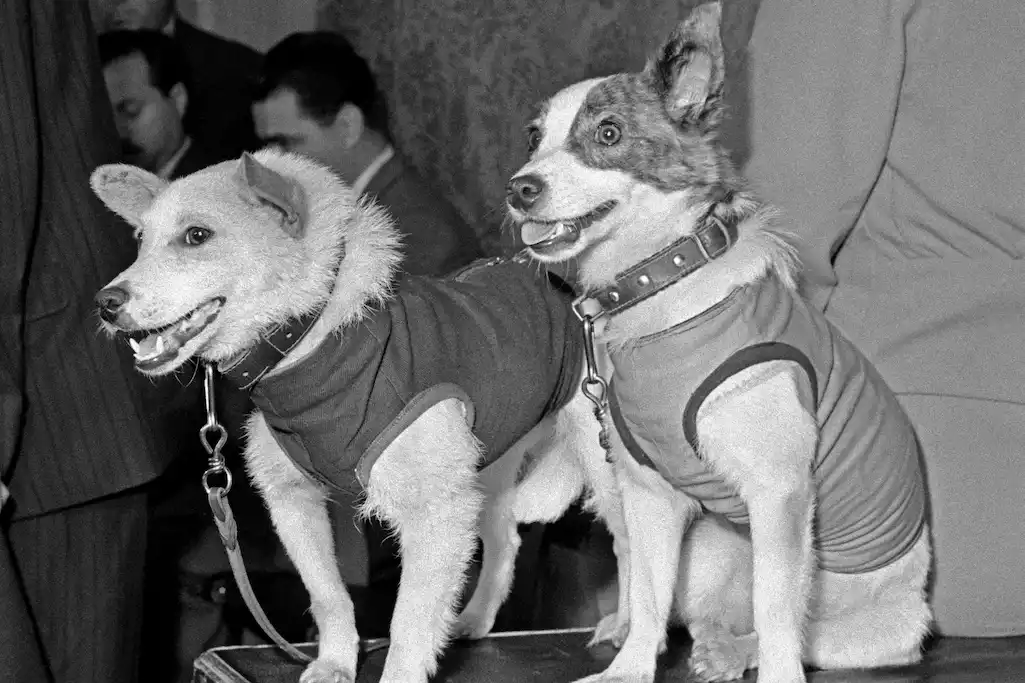
Belka and Strelka were two female dogs from the Soviet space programme who were launched aboard Korabl-Sputnik 2, also known as Sputnik 5, on 19 August 1960. After spending about 24 hours in orbit, both animals returned safely to Earth. The mission played an important role in preparations for human spaceflight.
Training and the August 1960 Flight
The Soviet Union had been using dogs in rocket experiments since the 1950s to study the effects of launch and flight on living organisms. Researchers generally selected small dogs that were hardy enough to withstand the demanding training and the confined space inside the capsules.
Belka and Strelka were prepared for the mission by spending time in cramped compartments and being exposed to vibrations and other tests designed to reproduce some of the conditions of a rocket launch. The Soviet programme also suffered serious accidents. On 28 July 1960, the dogs Bars and Lisichka were killed when the rocket that was supposed to carry them into space exploded.
A few weeks later, Belka and Strelka were selected for a new mission. Korabl-Sputnik 2 was a precursor to the Vostok spacecraft and was equipped with life-support systems, monitoring equipment and television cameras that allowed researchers to observe the animals’ behaviour.
The spacecraft was launched from Baikonur on 19 August 1960. Alongside Belka and Strelka were a rabbit, 40 mice, two rats, fruit flies, plants and other biological samples. The mission was intended both to study the effects of orbital flight on living organisms and to test systems that would later be used in the Vostok programme.
Belka and Strelka were monitored by telemetry and by cameras installed inside the cabin. During the fourth orbit, Belka became agitated and vomited. Her reaction drew the attention of Soviet doctors and contributed to the decision to limit the first crewed Vostok flight to a single orbit.
Strelka and the Puppy That Went to the White House
After the mission, Strelka gave birth to six puppies. One of them, a female puppy named Pushinka, was sent to the United States in 1961 after Nikita Khrushchev gave her to President John F. Kennedy’s family.
Pushinka became Caroline Kennedy’s pet and lived at the White House. She later had puppies with Charlie, one of the Kennedy family’s dogs.
After returning from space, Belka and Strelka became widely known throughout the Soviet Union. Their images appeared on stamps, postcards, badges, medals and other commemorative items, and their story was also featured in books and other works for children.
Unlike Laika, who had been sent into orbit in 1957 aboard a spacecraft with no system for returning her to Earth, Belka and Strelka were part of a mission in which the safe recovery of the animals was one of the main objectives.
The taxidermied remains of both dogs are preserved at the Museum of Cosmonautics in Moscow. The museum’s collection also includes the return capsule in which they came back to Earth, with marks from atmospheric re-entry and landing still visible on its surface.